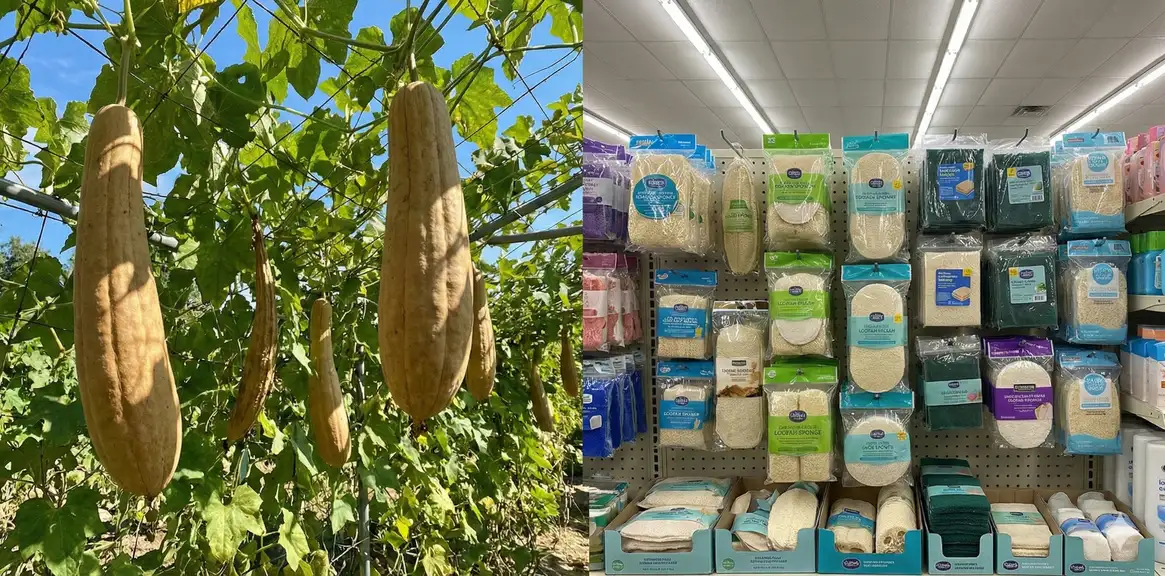
Should you buy a loofah from the store or grow your own? It's a question many eco-conscious consumers ask when transitioning to natural products. The answer depends on your circumstances, but the data clearly favors homegrown for most people.
We'll break down quality, cost, environmental impact, and convenience to help you make an informed decision. Whether you're already committed to sustainability or just exploring your options, understanding the full picture will help you choose the right path for your household.
This comprehensive guide examines both options objectively, so you can decide whether to start growing your own loofah or continue purchasing commercially grown ones. There are important sourcing considerations for either choice.
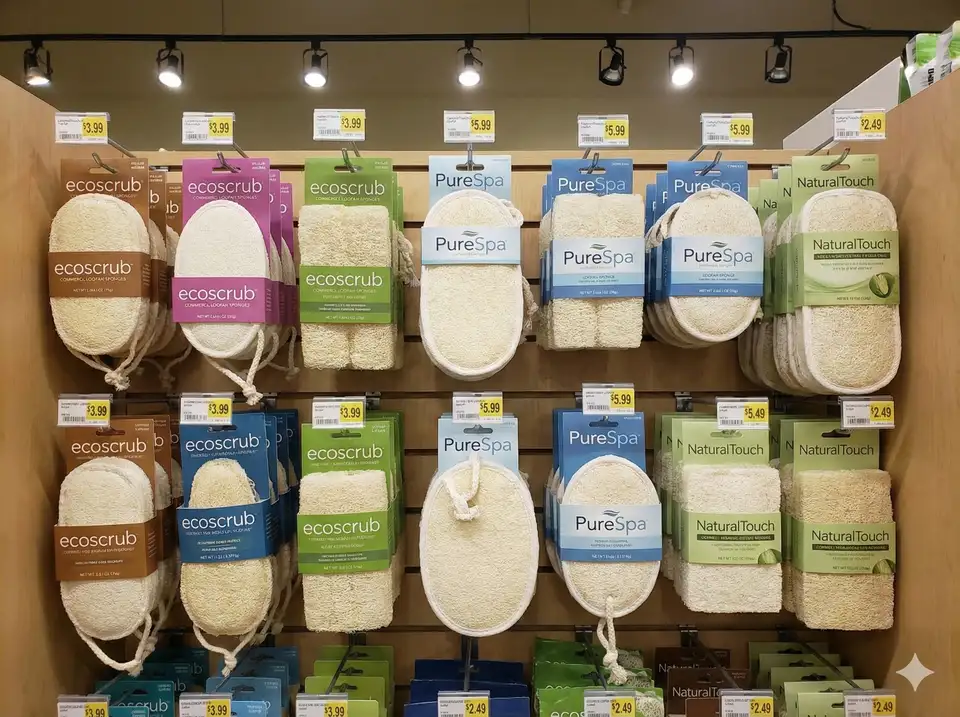
Side-by-Side Overview
Before diving into the details, here's a quick snapshot of how commercial and homegrown loofahs compare across the key factors that matter most to consumers.
Advantages:
- Available immediately when you need one
- No growing or gardening required
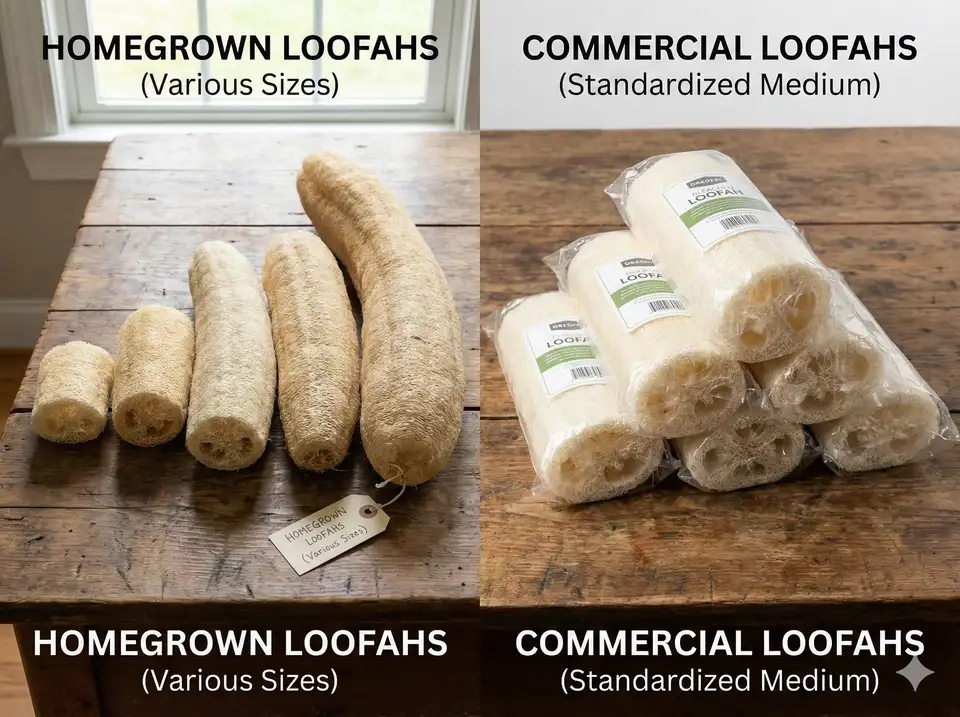
- Consistent sizing and shape
- Pre-processed and ready to use
Disadvantages:
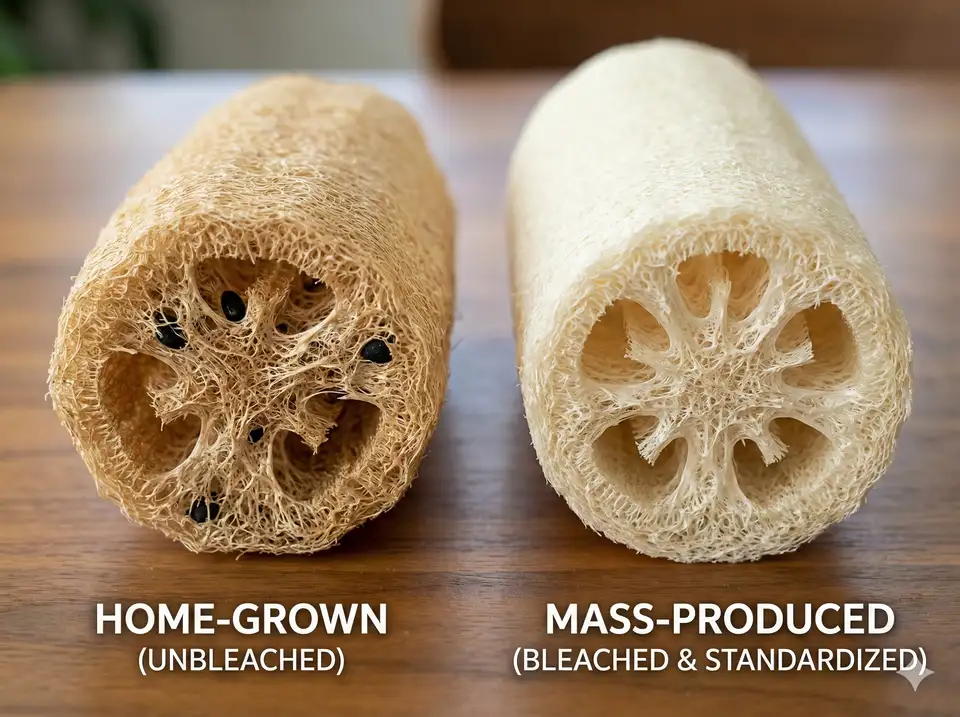
- Often bleached with chemicals for appearance
- Unknown age and freshness (could be years old)
- Higher cost per unit ($4-8 each)
- Carbon footprint from shipping
Advantages:
- Superior quality with denser, fresher fibers
- 100% natural and organic if grown without chemicals
- Very low cost ($0.10-0.50 per loofah after initial setup)
- Zero carbon footprint
Disadvantages:
- Requires time investment (150+ frost-free days)
- Needs garden space or large containers
- Climate dependent (warm weather required)
- Processing required after harvest - see home processing methods

Detailed Comparison
The following table breaks down the key factors that differentiate commercial and homegrown loofahs. Each category has a clear winner based on objective criteria, though your personal priorities may weight these factors differently.
| Factor | Commercial | Homegrown | Winner |
|---|---|---|---|
| Initial Cost | $3-8 per loofah | $3-5 for seeds (yields 50+) | Homegrown |
| Freshness | Unknown (months to years) | Harvest when ready | Homegrown |
| Chemical Treatment | Often bleached/treated | 100% natural if organic | Homegrown |
| Fiber Density | Varies widely | Controllable with timing | Homegrown |
| Convenience | Buy and use immediately | 5-6 month growing process | Commercial |
| Environmental Impact | Shipping, packaging | Zero footprint | Homegrown |
| Size Consistency | Standardized sizing | Varies by conditions | Commercial |
| Durability | 3-4 weeks typical | 4-8 weeks when fresh | Homegrown |
As you can see, homegrown loofahs win in 6 out of 8 categories. The only areas where commercial loofahs have an advantage are convenience (no growing required) and size consistency (standardized products). For most eco-conscious consumers, the tradeoffs clearly favor growing your own.
Quality Differences
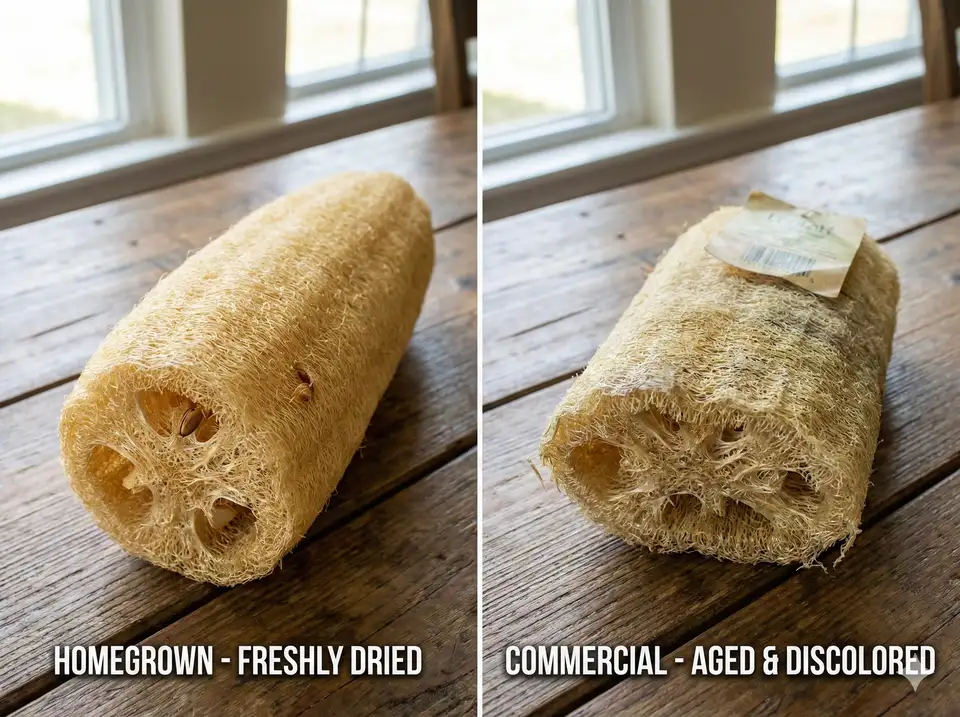
The most significant difference between commercial and homegrown loofahs is quality - and it's not even close. Fresh homegrown loofahs have denser, more resilient fibers that provide better exfoliation and last significantly longer than their store-bought counterparts.
Commercial Loofah Quality Issues
Most consumers don't realize what happens to loofahs before they reach store shelves. The commercial supply chain introduces several quality problems:
- Bleaching: Most commercial loofahs are bleached for a "clean" white appearance. This weakens fibers and adds chemicals to what should be a natural product. The bleaching process can reduce fiber strength by 20-30%.
- Age degradation: Loofahs sitting in warehouses and store shelves lose fiber integrity over time. You have no way of knowing when it was harvested - it could be months or even years old.
- Processing damage: Industrial processing can damage delicate fibers, reducing exfoliating effectiveness and lifespan. Mass processing prioritizes speed over quality.
- Preservatives: Some commercial loofahs are treated with antimicrobial chemicals to extend shelf life, defeating the purpose of using a natural product.
Homegrown Loofah Advantages
When you grow your own loofahs, you control every aspect of quality from seed to sponge:
- Peak freshness: Harvest and use within weeks for maximum fiber integrity and scrubbing power
- Control over texture: Harvest earlier for softer loofahs (great for facial use), or later for more scrubby texture (perfect for kitchen cleaning)
- No chemicals: With control over growing methods, you can grow organically for a truly natural product you can trust
- Full customization: Cut to any size or shape you need - body scrubbers, kitchen sponges, or specialty shapes for crafts

Cost Analysis
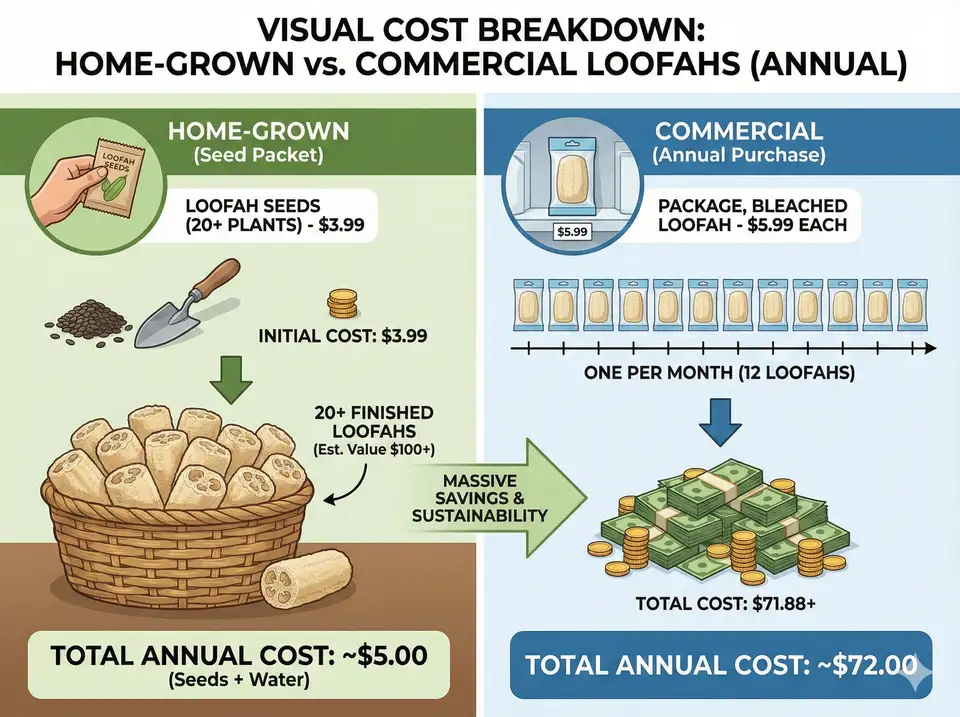
The economics strongly favor homegrown loofahs, especially after the first year when you can save your own seeds. Let's break down the numbers to see exactly how much you can save.
- Average price: $4-8 per loofah
- Lifespan: 3-4 weeks with proper care
- Annual cost: $52-104 per person (replacing every 3-4 weeks)
- Family of four: $208-416 per year
- Seeds: $3-5 for a packet (50+ seeds)
- Trellis/support: $20-50 (one-time investment)
- Water/fertilizer: Minimal additional cost
- Yield: 10-50 loofahs per vine
- Year 1 cost: ~$25-55 for 10+ loofahs
- Year 2+ cost: Save seeds = virtually free
After the first year, homegrown loofahs cost essentially nothing, while commercial loofahs continue to add up. A family of four could save $200-400 annually by growing their own. Over a decade, that's $2,000-4,000 in savings from a single $5 seed packet.
Environmental Impact
If sustainability matters to you, the choice is clear. A full carbon footprint comparison shows homegrown loofahs have virtually zero environmental impact, while commercial loofahs carry a significant carbon footprint that many consumers don't consider.
- Origin: Grown primarily in China and Vietnam
- Transportation: Shipped thousands of miles by container ship
- Packaging: Plastic packaging common
- Processing: Chemical bleaching and treatment
- Carbon footprint: Moderate to high
The irony is that many people buy natural loofahs to be eco-friendly, not realizing the environmental cost of shipping them around the world.
- Origin: Your own backyard
- Transportation: Zero emissions (walk to garden)
- Packaging: None needed
- Processing: Water only, no chemicals
- Carbon footprint: Effectively zero (even negative if composted)
When you compost spent loofahs, they actually return nutrients to the soil, creating a closed-loop system with net-positive environmental impact.
When to Buy Commercial
Despite the advantages of homegrown loofahs, commercial options make sense in certain situations. There's no shame in buying store-bought loofahs when circumstances prevent growing your own.
- No garden space: Apartment dwellers without outdoor areas or balconies may not have space for loofah vines, which need vertical support
- Short growing season: Northern climates with under 150 frost-free days may struggle to get loofahs to mature before frost
- Immediate need: You need a loofah right now and can't wait 5-6 months to grow one
- First-time users: Try a store-bought one to see if you like loofahs before committing to growing - it's a reasonable approach
- Gift giving: Need a loofah as a gift when yours aren't ready yet
If you do buy commercial loofahs, look for unbleached, minimally processed options - check our guide to quality commercial options. The natural brown color indicates no chemical bleaching, and these will generally be higher quality than bright white bleached versions.
- If you can grow: Do it. The quality difference is remarkable, the cost savings add up quickly, and there's immense satisfaction in growing your own bath products. Start with our complete growing guide.
- If you can't grow: Seek out unbleached, organic commercial options and replace them every 3-4 weeks for hygiene. Look for suppliers who prioritize quality over appearance.
- Best of both worlds: Buy commercial for now while starting your first plants. By next year, you'll be self-sufficient.
Related Guides
Recommended Products
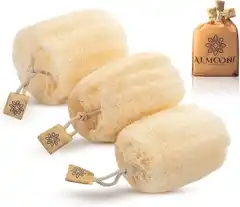
Almooni Egyptian Loofah Bath Sponges (3-Pack)
Premium thick-fiber natural loofahs - gentle exfoliation for all skin types - lasts 3-4 weeks each
Buy on Amazon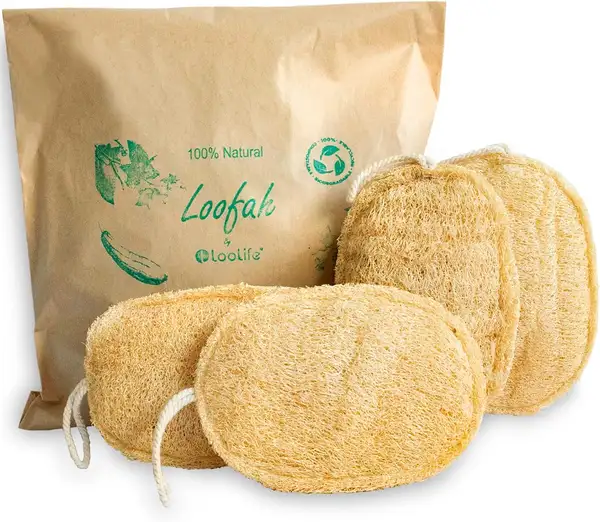
Natural Loofah Exfoliating Sponges (4-Pack)
100% organic biodegradable bath sponges - plastic-free alternative that's gentle on skin and planet
Buy on AmazonAs an Amazon Associate, we earn from qualifying purchases.